Early .seo Adopters: Stories from the First Wave of Minters
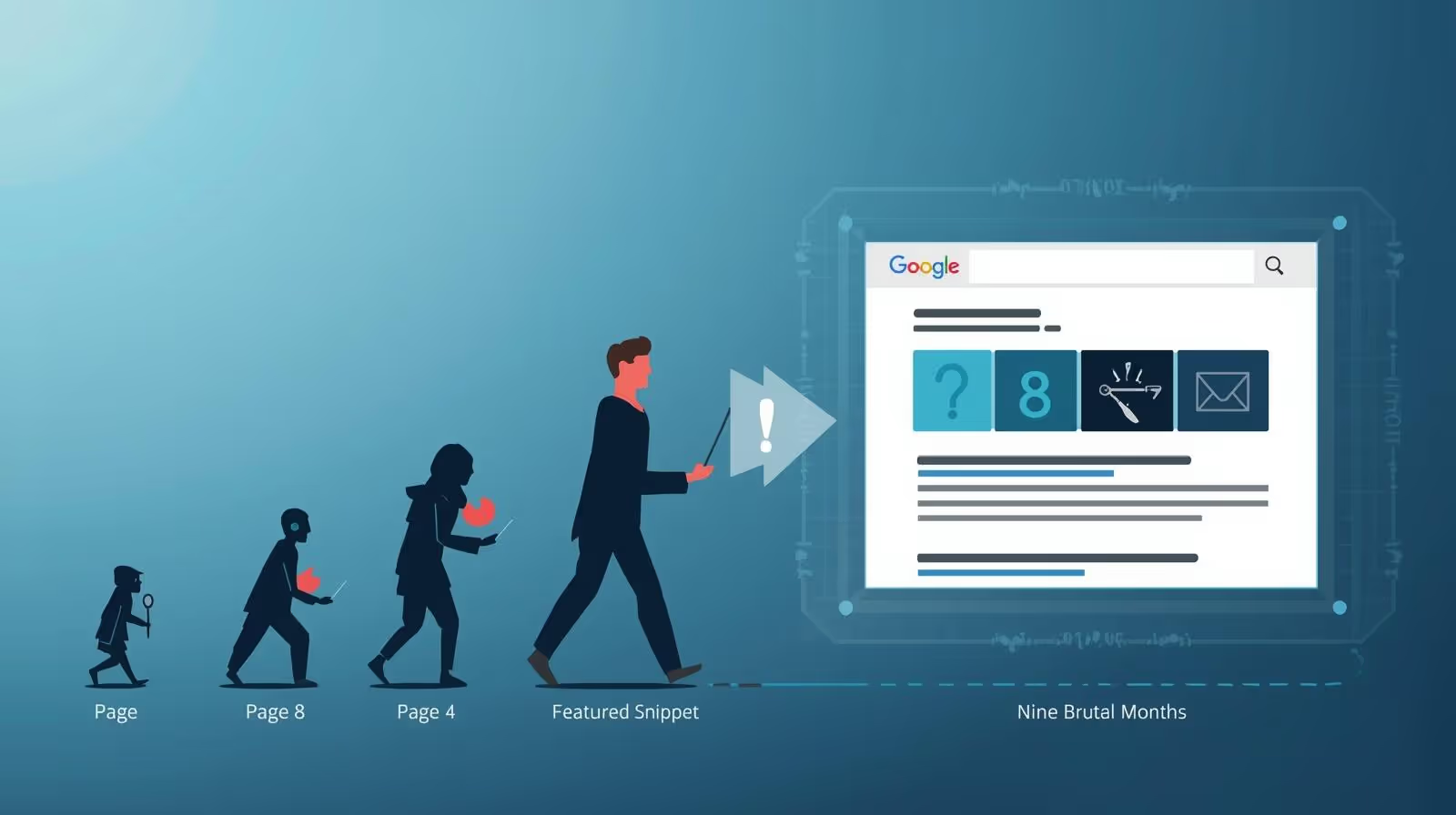
Minting a new kind of domain feels a bit like buying a shop sign on a street that’s still being built. Some people walk past and shrug, others stop, point, and remember the name. Early .seo minters did it with that exact mix of nerves and upside in their gut.
In this post, .seo means an onchain domain you hold in your crypto wallet, from a .seo naming program described as owned by Kooky and powered by Freename. Instead of “renting” a domain through a registrar each year, you mint a name to your wallet and can transfer it like a digital asset.
What follows isn’t hype or “easy rankings.” It’s the human side of early adoption, the patterns behind the wins and the regrets, and the practical moves SEO minded builders used to turn a name into results.
What a .seo domain is, why people minted early, and why it matters for SEO
A .seo domain (in this context) is an onchain name, owned by Kooky and powered by Freename, that lives on a blockchain rather than inside a traditional domain registrar account. When you mint it, you’re recording ownership to a wallet address on a public ledger.
That sounds technical, but the day-to-day meaning is simple:
- Minting: buying and registering the name onchain, usually as a one-time purchase plus network fees.
- Wallet: the account that holds your onchain assets (it’s more like a keychain than a bank).
- Onchain ownership: the record of who owns the name is public, and transfers don’t depend on a registrar support ticket.
- Renewal versus ownership: many onchain naming systems aim for “buy once, own it,” while traditional domains are ongoing rentals with renewals. Some projects may still attach optional paid services, but the core ownership record is onchain.
Why did people mint early? The honest answer is the same reason people grab a great handle on a social platform before it’s crowded. They wanted a name that’s short, memorable, and hard to copy, plus a niche signal that says “I’m about SEO” the moment someone sees it.
From an SEO angle, the domain itself doesn’t magically lift rankings. The value is what the name can do for human behavior: brand recall, click trust, and cleaner positioning in outreach, bios, and campaigns. If people remember you, search you by name, and mention you more, SEO benefits tend to follow.
Minting basics in plain English, what you actually get when you own .seo
When you own a .seo domain onchain, you’re not just reserving a string of letters. You control an asset recorded to your wallet, and that brings a few practical abilities.
What ownership usually includes
- Transferability: you can send the domain to another wallet, which can matter if you sell a project or move assets to a team-owned wallet.
- Public record: anyone can verify which wallet holds the domain, which adds clarity for deals and partnerships.
- Utility options: depending on the tools around the naming system, you can point the name to a profile, a redirect, a landing page, or use it in campaigns as a short, themed URL.
Early minters also ran into a few surprises. Gas or network fees can spike at the wrong time, so a mint that “costs X” can end up costing more in the moment. Wallet security is another wake-up call, because a stolen seed phrase doesn’t just risk one domain, it risks everything in that wallet. And then there’s the look-alike problem: if you mint a name with confusing spelling, people will type it wrong, talk about it wrong, and share the wrong link.
Why SEO people cared about the name itself, click trust, brand recall, and topical signals
SEO folks didn’t flock to .seo because Google rewards the extension. They cared because names shape behavior.
When someone sees a .seo link in a bio, a speaker page, or a pitch email, it can create an instant category cue. That cue can increase click confidence, especially when the rest of the message is tight and credible. If the name is simple, people also remember it and search it later, which feeds brand search and can lift performance across content that already deserves attention.
There are real limits, too. A .seo domain won’t fix weak offers, thin content, or sloppy technical SEO. It’s a sign on the door, not the product inside. The early adopters who got value treated the name as a marketing asset that supports good SEO work, not as a shortcut.
Stories from the first wave of .seo minters, the patterns behind the wins and regrets
Because public, verifiable case studies around .seo minters are still thin, the most useful way to learn is through true-to-life snapshots, the kinds of patterns early adopters repeatedly describe across onchain naming projects. Each one follows the same structure so you can compare the decisions, not just the outcomes.
The agency owner who minted a service name to close deals faster
Who: a small agency owner who sells SEO audits and content strategy
What they minted: a direct service name that matched their core offer
Why: they wanted a trust anchor that feels purpose-built for SEO, and a name clients can repeat without thinking
In the first month, they didn’t rebuild their whole site. They set up a clean landing page and used the .seo domain everywhere prospects make decisions: proposal PDFs, email signature, and outreach follow-ups. When a prospect asked, “Is this your main site?” they answered simply and linked to a proof page.
What worked was boring in the best way. They used the domain as a “front door” for one offer: a paid audit with a clear promise, a short timeline, and examples of past work. When leads clicked, they landed on a page built to remove doubt, not to impress.
What didn’t work was expecting the domain name to carry weak messaging. Early drafts of the page were stuffed with SEO buzzwords, and conversion didn’t move until they rewrote it in plain language.
Lesson: use a .seo domain to reduce friction in selling, not as a magic SEO boost. If the page answers “what do I get, when do I get it, and why should I trust you?” the name helps.
The solo creator who used .seo to build a niche content hub and grow brand searches
Who: a solo creator who writes and consults
What they minted: a niche topic name, not a broad “SEO” keyword grab
Why: they wanted a simple home for one topic they could own in conversation
In the first month, they published a small series instead of a big launch. Each piece focused on a narrow reader problem, and each post linked to a single “start here” page. The domain showed up in every profile and every collab, because repetition is what makes a name stick. When someone asked on a call, “Where can I find your stuff?” the answer was one short phrase.
What they tracked was practical: branded queries (people searching the name), newsletter signups, link mentions from others, and replies from outreach. The best signal wasn’t a ranking chart, it was the steady rise in “I heard about you from…” messages tied to the same domain.
What didn’t work was chasing too many topics. The moment they widened the scope, shares dropped and readers got confused.
Lesson: consistency beats cleverness. A .seo domain works best when it points to a focused idea, repeated until it becomes the default association.
The domain collector who over-minted and learned to focus on real use cases
Who: a domain collector with a taste for short names
What they minted: many names, including vague keywords
Why: fear of missing out, plus the thrill of “getting there first”
In the first month, the wallet looked impressive, but nothing shipped. Some names were too generic to brand, others were close to known brands (a problem they underestimated), and a few were hard to spell out loud. They assumed they could “figure it out later,” but later never came, because each name created a new decision.
What worked was the one time they stopped and asked, “Which name could I build around in a weekend?” They chose one strong, brandable domain and used it for a simple resource page and a lead magnet. That single page outperformed the rest of the portfolio combined, because it had a purpose.
What didn’t work was treating minting like collecting baseball cards. Without distribution and a real use case, most names stayed invisible.
Lesson: one strong name with a clear plan beats a wallet full of unused mints. If you can’t describe the first month of usage in one sentence, don’t mint.
The in-house SEO who minted defensively to protect a brand and campaigns
Who: an in-house SEO at a mid-size company
What they minted: the brand name, a product line name, a common misspelling, and a campaign tag
Why: brand protection, and cleaner campaign routing for partnerships
In the first month, the hard part wasn’t the mint. It was governance. Who controls the wallet, and what happens if that person leaves? They set up internal approvals and a documented process, then moved the assets into a team-controlled wallet structure.
What worked was treating the .seo domains as brand infrastructure. The campaign tag became a tidy redirect for partner promotions, and the brand mint reduced the risk of confusion if someone else grabbed it first.
What didn’t work was assuming everyone internally would understand onchain assets right away. Legal and finance needed plain explanations, plus a clear statement of why these names matter.
Lesson: defensive mints can be smart, but only if ownership and access are handled like any other core brand asset.
How early .seo adopters chose names, and what they would do differently now
Early minters learned fast that the “best” .seo name isn’t the most clever. It’s the one people remember, type, and share without friction. If someone hears it once on a podcast and can repeat it later, you’ve got something.
A simple naming framework, brandable first, keyword second, and always easy to say
Most first-wave wins follow one rule: brandable first, keyword second. Keywords can help positioning, but brandability is what makes word-of-mouth work.
A simple framework that doesn’t require tools:
- Keep it short: short names survive screenshots, bios, and quick mentions.
- Make it easy to say: if you have to spell it every time, you’ll lose the compounding effect.
- Avoid hyphens and confusing numbers: “2” versus “to” versus “too” becomes a support issue.
- Match your offer: an agency name should feel like a service you’d buy, a creator name should feel like a topic you’d follow.
- Run the one-hear test: tell a friend the name once, then ask them to text it back later in the day. If they miss it, your audience will too.
For agencies, the best names often hint at outcomes or a specialty. For local businesses, clarity matters more than cleverness. For creators, a narrow niche can beat a broad “SEO” label, because it gives people a reason to remember you.
Risk checks before you mint, trademarks, look alike names, and wallet safety
A .seo mint can feel casual, but it’s still a public, transferable asset. A few checks save real pain.
Trademark caution in plain language: if your domain looks like a known brand, or sounds like one, you’re taking a risk. Even if you mean well, it can create confusion and legal trouble. The safest play is to avoid anything that could be read as impersonation.
Look-alike names are another trap. If there’s a well-known site called ExampleSEO, minting Examp1eSEO.seo might look clever to you, but it reads as shady to everyone else.
Wallet safety matters even more:
- Keep seed phrases offline.
- Consider a hardware wallet if the name has real value.
- If a team owns the asset, consider multi-signature control so one person can’t move it alone.
Also check the “future you” risk. If you’re pivoting every few months, a super-specific name can box you in. If your positioning is stable, a focused name can become an anchor.
Putting a .seo domain to work for growth, practical plays that support real SEO results
A .seo domain earns its keep when it supports outcomes you can measure: more qualified clicks, more mentions, more replies, more links. The best early adopters picked one use case and made it obvious.
Use it as your campaign front door, a focused landing page, offer, and proof
Think of your .seo domain as the front door to a single promise. When someone clicks, they should know they’re in the right place within seconds.
A simple page stack works well:
- Clear promise: what you do, who it’s for, and what changes after.
- One call to action: book a call, join the list, download the guide.
- Proof points: short case notes, testimonials, screenshots, or outcomes stated plainly.
- Short FAQ: pricing range, timeline, what’s included, who it isn’t for.
Measurement stays basic on purpose. Track clicks, signups, booked calls, and branded mentions. If the domain shows up in more conversations and more people search your name later, you’re building the kind of demand that makes SEO easier.
Keep messaging consistent across channels. If your LinkedIn says one thing, your podcast bio says another, and your .seo page says a third, the name won’t stick.
Use it as a credibility layer in outreach, partnerships, and digital PR
Early adopters often got the biggest payoff in places where trust is thin. Cold outreach, partner intros, speaker pitches, and PR emails all rely on fast pattern-matching.
A .seo domain can help because it’s memorable and context-rich. When a journalist or host sees a clean, relevant domain, it can reduce the “who is this?” friction. That can lead to more replies, and replies are how you earn mentions and links.
A simple outreach script idea that stays human:
- One sentence on who you are and your angle
- One sentence on what you can share (a data point, a framework, a case)
- One link, your .seo page with proof and a short bio
Relevance beats volume. Ten well-matched pitches with a clear .seo landing page can outperform a hundred generic emails, and the SEO impact shows up later as branded searches, unlinked mentions, and earned links from real sites.
Conclusion
The first wave learned a clean lesson: minting early only pays off when the name is tied to a plan, not a hope. The .seo domain, onchain and held in your wallet, from a program described as owned by Kooky and powered by Freename, is strongest when it supports consistent publishing and smart promotion. Pick one use case, pick one name you can say out loud without spelling, and run a simple 30-day test that measures clicks, replies, and brand searches. If someone heard your domain once today, would they remember it tomorrow, and would they trust it enough to click?